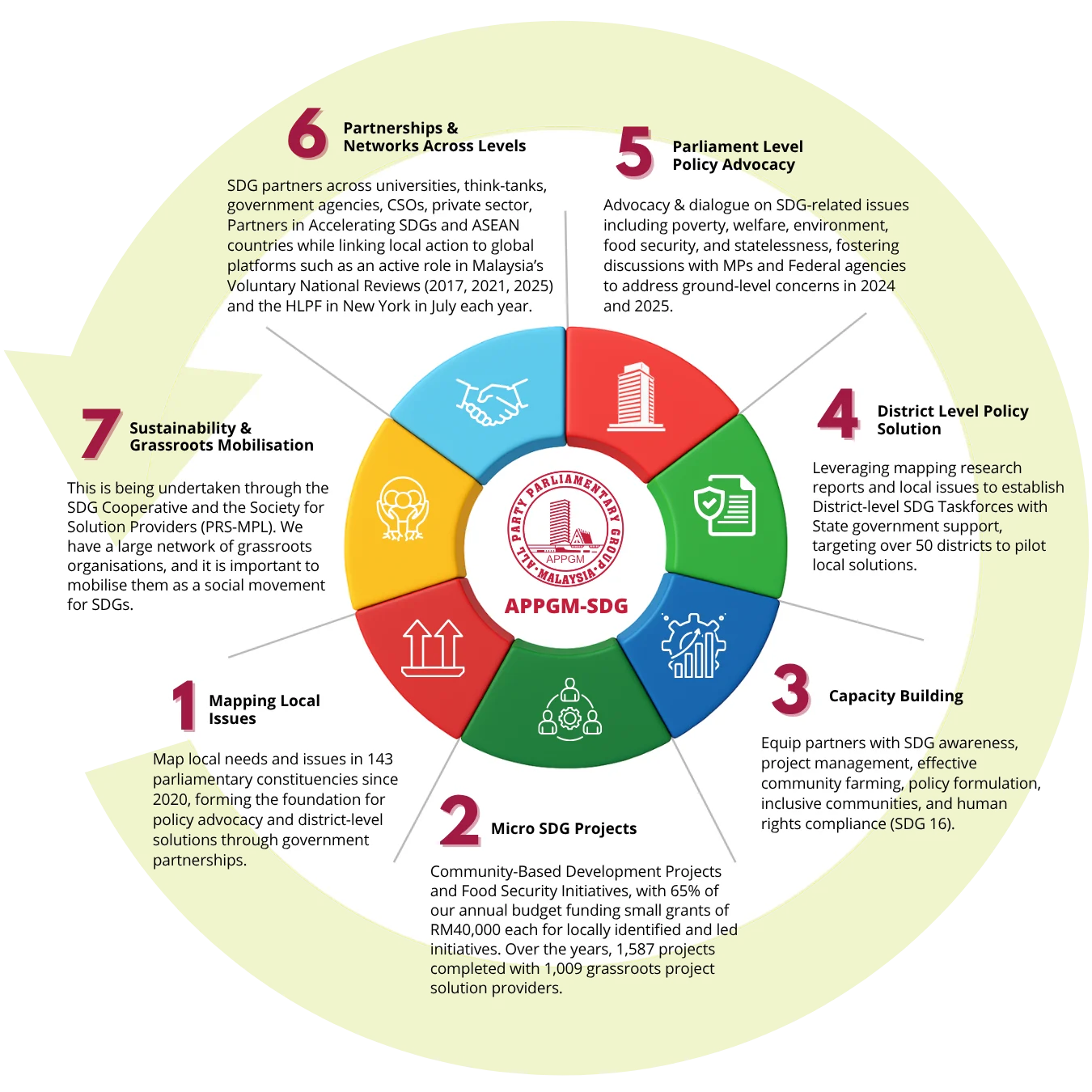
This section presents the seven key approaches that shape the depth and direction of APPGM-SDG. These guiding principles anchor our commitment to effective SDG localisation at the groundlevel. Each approach represents a refined area of work designed to strengthen implementation, drive transformative action, and ensure that no one is left behind.
Solving Local Issues and Concerns
through Multi-stakeholder Engagement
Key Approach 1: Mapping Local Issues
We adopt a “bottom-up needs assessment” approach to systematically map local needs and issues across parliamentary constituencies, forming a strong evidence base for policy advocacy and district-level solutions through partnerships with government agencies. This mapping process actively involves Members of Parliament (MPs), District Officers, and relevant agencies through structured focus group discussions. Importantly, it ensures the inclusion of diverse community voices, including women, youth, indigenous peoples, ethnic minorities, fishing communities, farmers, as well as B40 groups from both rural and urban settings. To date, research fieldwork has been conducted in 143 constituencies, generating comprehensive insights into local realities. The findings are then compiled into reports that are published and circulated to MPs and relevant agencies, enabling targeted interventions and more responsive policymaking.
Key Approach 2: Micro SDG Projects
We implement micro-SDG community-based solution projects, including initiatives such as community farming, by allocating 65% of our annual budget to small grants of RM40,000 each for locally identified and led projects. These initiatives span a wide range of community needs, including training for women in digital marketing, the establishment of community learning centres for children, youth, and adults, mangrove replanting efforts, and the development of community-based tourism.
All projects are defined and driven by local solution providers, ensuring that interventions are grounded in the realities and priorities of the communities themselves. To date, a total of 1,587 projects have been completed in collaboration with 1,009 grassroots partners, including social enterprises, academic institutions, cooperatives, societies, and community-based organisations. Throughout the process, we play a facilitative role by identifying suitable partners, reviewing project proposals, monitoring implementation, and ensuring proper reporting and accountable financial utilisation.
Key Approach 3: Capacity Building
We organise capacity-building programmes to strengthen knowledge and skills in areas such as SDG awareness, project management, effective community farming, policy formulation, inclusive community development, and human rights compliance (SDG 16). These programmes are designed to support a wide range of stakeholders, including civil servants, local community leaders, CSO and NGO volunteers, young politicians, and university students. Delivered primarily at the district level, the training aims to expand the pool of SDG practitioners and activists while fostering greater coordination and capacity among those involved in implementing and sustaining local development initiatives.
Key Approach 4: District-Level Policy Solutions
We advance district-level policy solutions by leveraging findings from mapping research reports and local issues to establish SDG District-Level Taskforces with the support of State governments, targeting over 55 districts for piloting local solutions. These taskforces are secured through State government backing and grounded in evidence gathered from fieldwork, ensuring that proposed interventions are both relevant and actionable. In-depth engagements are conducted with district offices and relevant agencies to collaboratively develop context-specific solutions that address local challenges. Moving forward, these solutions will be pilot-tested across more than 55 districts, providing a practical pathway for scaling effective, community-informed policy interventions.
Key Approach 5: Parliament-Level Policy Advocacy
We organise parliamentary-level policy dialogues on key SDG-related issues such as poverty, welfare, the environment, food security, and statelessness, fostering meaningful discussions between Members of Parliament (MPs) and federal agencies to address concerns emerging from the ground in 2024 and 2025. These dialogues are informed by field-based findings and provide a platform for translating local issues into national policy conversations. As a result, eight parliamentary policy reports have been prepared and finalised with input from multiple agencies, reflecting a collaborative and consultative approach. Importantly, these reports serve as tangible examples of bipartisan consensus, reinforcing APPGM-SDG’s role as a platform for bridging diverse political perspectives in advancing sustainable development.
Key Approach 6: Partnerships & Networks Across Levels
We build and strengthen strategic networks with SDG partners across universities, think tanks, government agencies, civil society organisations (CSOs), the private sector, and ASEAN countries, while linking local action to regional and global platforms. This includes expanding partnerships through initiatives such as Partners in Accelerating SDGs, as well as fostering cross-border collaboration with ASEAN neighbours, including co-creating and strengthening partnerships through the ASEAN SDG-SSE Roadmap. We also place strong emphasis on youth engagement by working closely with youth organisations, SDG agents, and university groups to nurture the next generation of leaders. At the global level, we actively contribute to Malaysia’s Voluntary National Reviews (2017, 2021, 2025) and participate in the United Nations High-Level Political Forum (HLPF) in New York. Through regular involvement in HLPF side events, we showcase local-to-global success stories, highlighting the impact of community-driven SDG implementation.
Key Approach 7: Sustainability & Grassroots Mobilisation
We ensure sustainability and strengthen grassroots movements for the SDGs. This is undertaken through the SDG Cooperative and the Society for Solution Providers(SP Society). We have a large network of grassroots organisations, and it is important to move them as a social movement for the SDGs. A good example of this grassroots showcase was the Tamu SDG event held at the Parliament. We are conscious that in the long term, we need to build capacity, marketing local products, mobilising savings and investment to ensure sustainability of local action. We are also seeking to reduce our dependency on public funds through social solidarity economy efforts for wealth creation at the grassroots.